
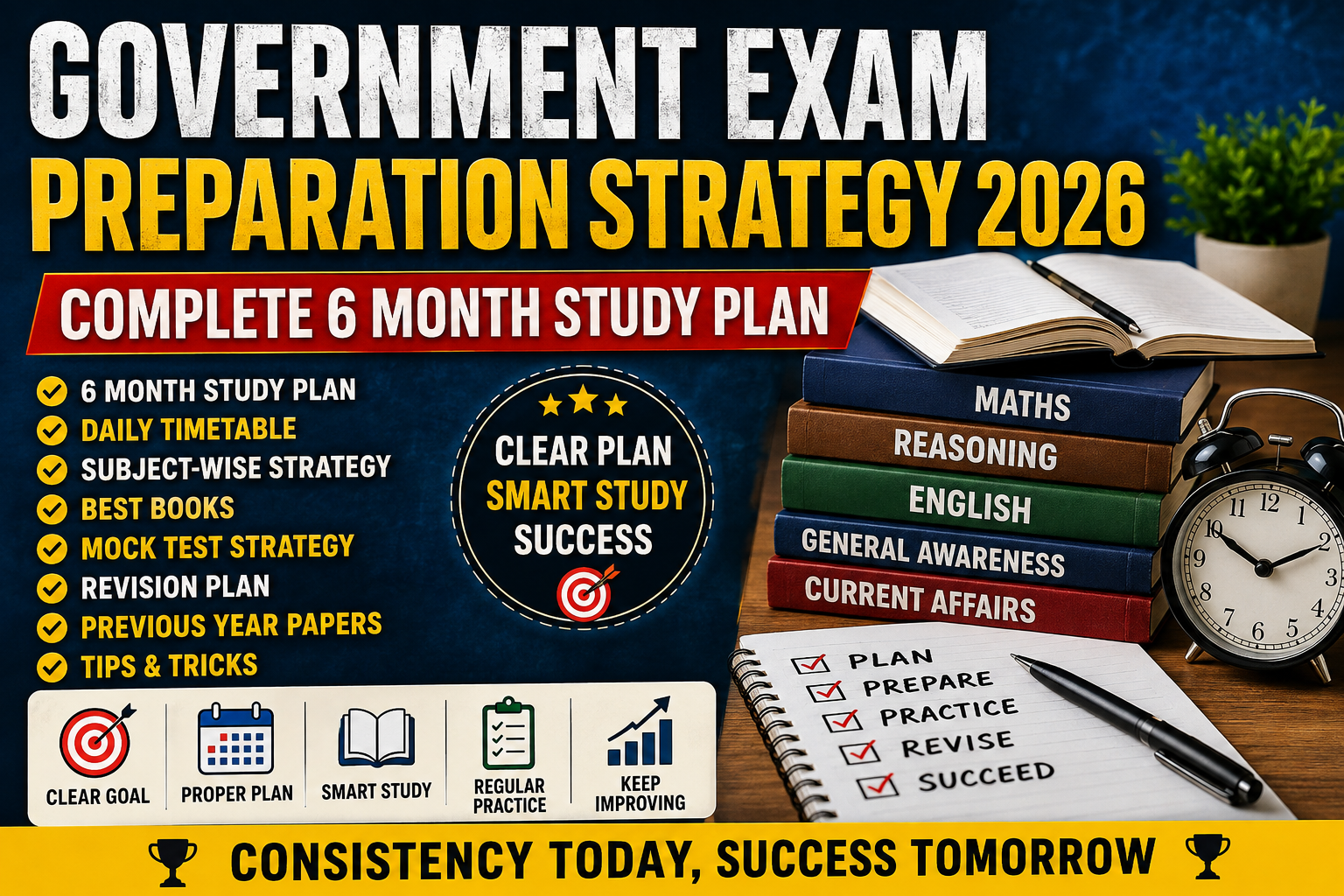
Government Exam Preparation Strategy 2026: Complete 6 Month Study Plan
Government exam preparation requires a proper strategy, consistent practice and regular revision. Candidates preparing for SSC, Railway, Banking, Defence, Police, Teaching, State PSC and other competitive examinations often spend several months studying, but without a proper plan, a large amount of time can be wasted.
A successful preparation strategy is not about studying for 15 hours every day. It is about understanding the syllabus, selecting the right study material, practising previous year questions, taking mock tests, analysing mistakes and revising regularly.
This detailed guide explains a practical 6-month government exam preparation strategy for 2026, including a daily timetable, subject-wise preparation plan, mock test strategy, revision technique, current affairs preparation and final 30-day strategy.
1. Understand Your Government Examination First
Before opening your books or joining a test series, understand the examination you are preparing for.
Different government examinations have different:
- Eligibility criteria
- Age limits
- Educational qualifications
- Examination patterns
- Syllabuses
- Number of questions
- Marking schemes
- Negative marking
- Selection processes
- Examination stages
Why Examination Analysis Is Important
Knowing the examination pattern helps you create a focused study plan.
For example, if an examination gives more weight to Mathematics and Reasoning, you should allocate sufficient daily time to these subjects. Similarly, if General Awareness or Current Affairs carries significant marks, it should not be ignored until the last month.
Details You Should Check
Before starting preparation, note down the following information:
| Information | What to Check |
|---|---|
| Examination Name | Exact name of the recruitment/examination |
| Eligibility | Educational qualification and other requirements |
| Age Limit | Minimum and maximum age |
| Exam Pattern | Sections, questions and marks |
| Duration | Total examination time |
| Negative Marking | Marks deducted for wrong answers |
| Syllabus | Complete subject-wise syllabus |
| Selection Process | Written exam, skill test, interview, etc. |
| Important Dates | Application and examination dates |
Always verify the latest official notification before relying on any examination information.
2. Analyse the Complete Syllabus
The syllabus should become the foundation of your preparation.
Do not start preparing random topics from different books and websites. First create a complete syllabus checklist.
Divide Your Syllabus Into Subjects
A typical competitive examination may contain:
| Subject | Important Topics |
|---|---|
| Mathematics | Percentage, Ratio, Average, Profit & Loss, Interest, Time & Work, Speed & Distance |
| Reasoning | Series, Coding-Decoding, Analogy, Blood Relations, Direction, Syllogism, Puzzles |
| English | Grammar, Vocabulary, Error Detection, Sentence Improvement, Comprehension |
| General Awareness | History, Geography, Polity, Economy, Science |
| Current Affairs | National, International, Sports, Awards, Appointments, Schemes |
Create a Topic Checklist
After preparing the syllabus, divide every topic into four categories:
- Completed
- In Progress
- Weak
- Not Started
This simple system gives you a clear picture of your preparation.
Prioritise Weak Topics
Do not spend all your time studying topics that you already know.
If Mathematics is your weak subject, give it additional time every day.
If Reasoning is already strong, maintain it through regular practice rather than spending most of your preparation time on it.
3. Six Month Government Exam Preparation Plan
A six-month preparation period can be divided into six different stages.
Month 1 – Build Your Basic Concepts
The first month should focus on foundation building.
Your main objective should be understanding concepts rather than solving questions extremely quickly.
Focus Areas
- Basic Mathematics
- Basic Reasoning
- English Grammar
- General Awareness fundamentals
- Current Affairs
Mathematics
Start with:
- Number System
- Simplification
- Percentage
- Ratio
- Average
- Profit and Loss
- Simple Interest
Reasoning
Start with:
- Analogy
- Classification
- Series
- Coding-Decoding
- Blood Relations
- Direction Sense
English
Focus on:
- Parts of Speech
- Tenses
- Articles
- Prepositions
- Subject-Verb Agreement
- Basic Vocabulary
Month 2 – Complete Important Topics
The second month should focus on completing the major topics of the syllabus.
Create Short Notes
Prepare short notes for:
- Important formulas
- Grammar rules
- Important facts
- Government schemes
- Important dates
- Difficult concepts
- Frequently repeated questions
Do not make extremely long notes.
Your notes should be short enough to revise quickly before the examination.
Start Topic-Wise Practice
After completing each chapter, solve questions related to that chapter.
For example:
Percentage → Learn Concept → Solve Basic Questions → Solve Previous Year Questions → Analyse Mistakes
This approach is more effective than simply reading the chapter and moving to the next one.
4. Month 3 – Previous Year Question Papers
The third month should give more importance to previous year questions.
Previous year papers are extremely useful because they show you how concepts are actually tested in the examination.
What Previous Year Papers Tell You
They help you understand:
- Question difficulty
- Frequently asked topics
- Question patterns
- Repeated concepts
- Time requirements
- Important chapters
- Expected level of preparation
How to Use Previous Year Papers
Do not simply solve a paper and check your marks.
After completing the paper, divide your questions into:
| Type | Meaning |
|---|---|
| Correct | Question solved correctly |
| Concept Mistake | Concept was not clear |
| Calculation Mistake | Calculation error |
| Silly Mistake | Careless error |
| Time Consuming | Too much time required |
| Unattempted | Could not solve |
This analysis helps you identify your actual weaknesses.
5. Month 4 – Increase Practice
By the fourth month, your basic concepts should be reasonably strong.
Now increase your question-solving practice.
Suggested Daily Practice
| Subject | Suggested Time |
|---|---|
| Mathematics | 2 Hours |
| Reasoning | 1.5 Hours |
| English | 1.5 Hours |
| General Awareness | 1 Hour |
| Current Affairs | 1 Hour |
| Previous Year Questions | 1 Hour |
| Revision | 1 Hour |
This is only an example.
You can adjust the timetable according to your college, job, family responsibilities and personal routine.
Focus On Accuracy First
Do not immediately try to solve questions at maximum speed.
First make your answers accurate.
Once accuracy becomes consistent, start working on speed.
6. Month 5 – Mock Tests and Performance Analysis
The fifth month should focus heavily on mock tests and weak areas.
Start Full-Length Mock Tests
Take mock tests according to the actual examination pattern.
Try to reproduce examination conditions:
- Fixed time
- No unnecessary breaks
- No mobile phone
- No books
- No external help
Analyse Every Mock Test
After each test, record:
| Metric | Your Performance |
|---|---|
| Total Questions | — |
| Attempted | — |
| Correct | — |
| Incorrect | — |
| Unattempted | — |
| Accuracy | — |
| Score | — |
| Time Used | — |
Do not take another mock test immediately without analysing the previous one.
Mock test analysis is as important as the mock test itself.
7. Month 6 – Revision and Final Preparation
The sixth month should primarily focus on revision and performance improvement.
Avoid starting several new books during the final month.
Focus On
- Short notes
- Formula sheets
- Previous year papers
- Mock tests
- Current affairs
- Weak topics
- Important facts
- Time management
What You Should Avoid
Avoid:
- Collecting too many new books
- Watching unlimited strategy videos
- Changing your preparation source repeatedly
- Ignoring revision
- Studying completely new topics at the last moment
Your goal should be to strengthen what you have already studied.
8. Daily Study Timetable for Government Exam Preparation
A timetable should be realistic.
Studying for 14 hours on one day and then doing nothing the next day is not a sustainable strategy.
Sample Daily Timetable
| Time | Activity |
|---|---|
| 6:00 AM – 7:00 AM | Current Affairs |
| 7:00 AM – 9:00 AM | Mathematics |
| 10:00 AM – 11:30 AM | Reasoning |
| 12:00 PM – 1:30 PM | English |
| 3:00 PM – 4:00 PM | General Awareness |
| 5:00 PM – 6:00 PM | Previous Year Questions |
| 7:00 PM – 8:00 PM | Mock/Practice Test |
| 9:00 PM – 10:00 PM | Revision |
How to Make Your Timetable Effective
Your timetable should include:
- New topic learning
- Question practice
- Revision
- Mock tests
- Current affairs
- Mistake analysis
Do not create a timetable that is impossible to follow.
Consistency is more important than an unrealistic number of study hours.
9. Mathematics Preparation Strategy
Mathematics can become a high-scoring subject when concepts are clear and sufficient practice is done.
Important Mathematics Topics
- Number System
- Simplification
- Percentage
- Ratio and Proportion
- Average
- Profit and Loss
- Simple Interest
- Compound Interest
- Time and Work
- Pipes and Cisterns
- Time, Speed and Distance
- Algebra
- Geometry
- Mensuration
- Data Interpretation
Maintain a Formula Notebook
Create a dedicated notebook for formulas.
For every formula, write:
Formula → Meaning → Example → Common Mistake
Revise this notebook regularly.
How to Improve Mathematics
Start with basic questions.
Then move to:
Basic → Moderate → Previous Year → Advanced/Time-Based
Do not focus only on shortcuts.
Understand the basic method first.
10. Reasoning Preparation Strategy
Reasoning improves significantly with practice.
Important Topics
- Analogy
- Classification
- Number Series
- Alphabet Series
- Coding-Decoding
- Blood Relations
- Direction Sense
- Ranking
- Syllogism
- Venn Diagram
- Statement and Conclusion
- Seating Arrangement
- Puzzles
Improve Reasoning Speed
First learn the correct method.
Then solve questions repeatedly.
After your accuracy improves, introduce a timer.
For puzzle-based questions, learn how to quickly identify:
- Given information
- Conditions
- Possibilities
- Fixed positions
- Relationships
11. English Preparation Strategy
English preparation should cover grammar, vocabulary and comprehension.
Important Grammar Topics
- Parts of Speech
- Tenses
- Articles
- Prepositions
- Subject-Verb Agreement
- Active and Passive Voice
- Direct and Indirect Speech
- Conjunctions
- Modals
Vocabulary Preparation
Learn:
- Synonyms
- Antonyms
- One Word Substitution
- Idioms and Phrases
- Commonly confused words
Reading Practice
Regular reading can improve comprehension and vocabulary.
Instead of memorising hundreds of words without context, try to understand how words are used in sentences.
12. General Awareness Preparation
General Awareness has a wide syllabus, so preparation should be organised.
Important Areas
History
Focus on major events, movements, important personalities and important dates relevant to the examination.
Geography
Study:
- Indian geography
- Rivers
- Mountains
- Climate
- Agriculture
- Natural resources
- Important locations
Indian Polity
Focus on:
- Constitution
- Fundamental Rights
- Fundamental Duties
- Parliament
- President
- Prime Minister
- Supreme Court
- Constitutional bodies
Economy
Study basic concepts such as:
- Banking
- Inflation
- GDP
- Budget
- Monetary policy
- Fiscal policy
- Financial institutions
General Science
Cover basic concepts of:
- Physics
- Chemistry
- Biology
- Everyday science
13. Current Affairs Preparation Strategy
Current Affairs should be prepared regularly rather than being left entirely for the last month.
Important Current Affairs Categories
- Government Schemes
- National News
- International News
- Defence
- Banking
- Economy
- Science and Technology
- Sports
- Awards
- Important Appointments
- Books and Authors
- Important Days
- Summits and Conferences
Make Short Current Affairs Notes
For every important event, note:
What happened?
When did it happen?
Who/which organisation was involved?
Why is it important?
This makes revision easier.
14. Previous Year Question Paper Strategy
Previous year papers should be included throughout your preparation.
Do not wait until the last month.
Topic-Wise Method
For each chapter:
Learn → Practise → Previous Year Questions → Analyse → Revise
For example:
Percentage
First learn the concept.
Then solve basic questions.
Then solve previous year questions.
Then record mistakes.
Finally revise the topic after a few days.
Maintain a Mistake Notebook
A mistake notebook can become one of your most useful revision resources.
Write only important mistakes.
Do not copy the complete question paper into the notebook.
15. Mock Test Strategy
Mock tests help you understand your actual examination readiness.
When Should You Start Mock Tests?
You can start topic-wise tests after completing individual chapters.
Once a substantial portion of the syllabus is completed, start full-length tests.
After Every Mock Test Ask Yourself
- Which section was strongest?
- Which section was weakest?
- Where did I lose marks?
- Which questions took too much time?
- How many mistakes were due to lack of knowledge?
- How many mistakes were due to carelessness?
- Did I attempt questions unnecessarily?
This analysis gives you a clear direction for further preparation.
16. How to Improve Speed and Accuracy
Government examinations often provide limited time.
You need both speed and accuracy.
Step 1 – Build Concept Clarity
Understand the basic method.
Step 2 – Improve Accuracy
Solve questions without worrying too much about time.
Step 3 – Add a Timer
Once accuracy becomes stable, start using time limits.
Step 4 – Identify Slow Topics
Find topics where you spend too much time.
Step 5 – Improve Question Selection
Not every question needs to be solved.
Learn to skip questions that are taking too much time.
Remember
Fast solving with low accuracy is not useful.
First become accurate, then become faster.
17. Revision Strategy
Revision should be planned from the beginning.
A useful revision cycle can be:
| Revision | Suggested Time |
|---|---|
| First Revision | Within 24 hours |
| Second Revision | After 7 days |
| Third Revision | After 2–3 weeks |
| Final Revision | Before Examination |
The exact schedule can be adjusted according to your memory and preparation level.
What Should You Revise?
Give priority to:
- Formulas
- Short notes
- Mistake notebook
- Current affairs
- Important facts
- Difficult topics
- Previous year questions
18. Track Your Preparation Progress
Do not depend only on how many hours you studied.
Track actual performance.
Sample Preparation Tracker
| Subject | Topics Completed | Questions Solved | Accuracy | Status |
|---|---|---|---|---|
| Mathematics | 18 | 850 | 82% | Good |
| Reasoning | 15 | 700 | 88% | Good |
| English | 12 | 600 | 79% | Needs Revision |
| General Awareness | 20 | 500 | 74% | Needs Improvement |
Update this every week.
What Should You Track?
Track:
- Topics completed
- Questions solved
- Mock tests taken
- Accuracy
- Average score
- Weak chapters
- Revision status
This gives you measurable progress.
19. Common Mistakes Candidates Should Avoid
Mistake 1 – Studying Without a Plan
Random preparation can result in incomplete syllabus coverage.
Create weekly and monthly targets.
Mistake 2 – Using Too Many Study Sources
Using five different books for the same subject can create confusion.
Select reliable study material and revise it properly.
Mistake 3 – Ignoring Previous Year Questions
Previous year papers show the actual question pattern.
Do not ignore them.
Mistake 4 – Taking Mock Tests Without Analysis
Taking 50 mock tests does not automatically mean you are prepared.
Analyse every important mistake.
Mistake 5 – Ignoring Weak Subjects
Do not always study your favourite subject.
Give additional time to weak areas.
Mistake 6 – Not Revising
Revision is essential.
Without revision, previously studied information can become difficult to recall.
Mistake 7 – Comparing Yourself With Other Candidates
Every candidate has a different background.
Compare your current score with your previous score.
20. Final 30 Days Government Exam Strategy
The final 30 days should focus on strengthening your preparation.
First 10 Days
Focus on:
- Full syllabus revision
- Weak chapters
- Previous year papers
- Current affairs
Next 10 Days
Focus on:
- Full-length mock tests
- Mistake analysis
- Time management
- Formula revision
Final 10 Days
Focus on:
- Short notes
- Important facts
- Current affairs
- Previous mistakes
- Selected previous year questions
Avoid completely changing your preparation strategy at the last moment.
21. Final 7 Days Before Examination
The last week should be used for light but effective revision.
Revise
- Formula notebook
- Current affairs notes
- Important facts
- Mistake notebook
- Important previous year questions
Avoid
- Starting a completely new book
- Studying continuously without breaks
- Taking too many difficult mock tests
- Staying awake unnecessarily late
- Comparing your preparation with others
Keep your documents and examination-related requirements ready in advance.
22. How to Stay Consistent During Preparation
Consistency is one of the biggest factors in competitive exam preparation.
You may not have a perfect study day every day.
Some days you may study for eight hours.
Some days you may only manage four hours.
The important thing is to continue the preparation.
Follow the 3-Step Rule
Study
Learn something new.
Practise
Solve questions.
Revise
Review what you learned earlier.
If these three activities are part of your routine, your preparation remains balanced.
23. Frequently Asked Questions
Can I prepare for a government exam in six months?
Yes. Six months can be sufficient for many examinations if you follow a structured plan, understand the syllabus, practise regularly and revise consistently.
How many hours should I study every day?
There is no universal number of hours. The quality and consistency of study are more important than simply increasing study hours.
Are previous year papers really important?
Yes. Previous year papers help you understand question patterns, difficulty levels and frequently tested topics.
When should I start taking mock tests?
Topic-wise tests can be started after completing individual chapters. Full-length mock tests can be introduced after completing a substantial portion of the syllabus.
How should I prepare Current Affairs?
Prepare Current Affairs category-wise and revise regularly. Focus on events relevant to your examination.
Should I study multiple books?
Usually, it is better to use limited and reliable study material and revise it multiple times rather than collecting too many books.
How can I increase my mock test score?
Analyse your mistakes after every mock test. Identify weak subjects, improve accuracy and practise time management.
How can I improve accuracy?
Find the reason behind every wrong answer. Determine whether the mistake happened because of a concept gap, calculation error, misunderstanding or carelessness.
Is revision more important than learning new topics?
Both are important, but learning without revision is less effective. Revision ensures that previously studied information remains available during the examination.
What should I do in the last month?
Focus on revision, previous year papers, mock tests, current affairs, weak areas and time management. Avoid unnecessarily changing your study resources.
24. Conclusion
Government exam preparation is not a one-day process. It requires a combination of planning, discipline, practice, revision and performance analysis.
A successful preparation strategy should include:
- Complete syllabus analysis
- A realistic daily timetable
- Strong concept building
- Previous year question practice
- Regular mock tests
- Current affairs preparation
- Continuous revision
- Mistake analysis
- Time management
- Performance tracking
Do not measure your preparation only by the number of hours you sit with your books.
Measure your preparation by your accuracy, mock test score, syllabus completion, question-solving ability and improvement over time.
If your score is gradually increasing, your accuracy is improving and your weak subjects are becoming stronger, your preparation is moving in the right direction.
Most importantly, candidates should always verify the latest examination notification, eligibility, vacancies, dates, syllabus and application instructions from the official website of the concerned examination authority before making any final decision.
Stay consistent, practise regularly, revise what you study and analyse your mistakes. Small improvements every day can make a significant difference over the entire preparation period.

Comments (0)
Login to leave a comment.